
From Helene Storm Damage to Hardwood Floors: Hauling a Homeowner’s Salvaged Oak

A homeowner in Fairview North Carolina found us online while searching for a local Asheville-area company that could lift and transport hardwood flooring. The flooring was waiting at Bee Tree Hardwoods, a mill in Swannanoa. What made the job memorable was where the wood came from. The flooring was cut from the homeowner’s own trees, which came down on their property during Hurricane Helene two years ago. Rather than paying to have the trees hauled off, they had them milled into hardwood flooring for their house. Why More Helene Trees Didn’t Become Lumber After Helene, Western North Carolina was covered in downed timber. Plenty of homeowners looked at the oaks, poplars and maples lying across their yards and wondered whether they could put that wood to use. Some did, and this homeowner is one of them. But it happens a lot less often than you might expect. The main reason is that turning your own trees into lumber isn’t necessarily cheaper than buying lumber off the shelf, and it’s definitely not free. Here’s what the process involves: Every one of those steps takes labor, equipment and time. The total cost isn’t necessarily higher than store-bought flooring, but for many people the gap between “I already own these trees” and “this still costs real money and takes a long time” is too big. For a lot of homeowners with a vision of turning storm-damaged trees into something useful and meaningful, the plan ends soon after they start researching it. Timing Matters More Than You Think If you’re considering salvaging fallen trees, the clock starts the day they come down. Once a tree is on the ground, fungi and insects start working on it right away. The NC Forest Service’s storm-salvage timetable gives hardwood intended for veneer and appearance lumber, which includes flooring, a window of about 4 to 6 weeks. After that, blue stain, decay and insect damage make the wood unsuitable for that use. Lower grades hold up longer. Pine framing lumber gets about 3 to 4 months, and pulpwood about 8 to 12 months. A few things can speed that clock up or slow it down: Now that it’s been more than two years since Helene, logs that have been lying on the ground since the storm are generally past flooring grade. That doesn’t mean they’re worthless. Depending on the species and condition, they may still work for rustic or character lumber, live-edge slabs (spalted wood can be especially striking), fence boards, landscape timbers or firewood. A local sawyer can look at the ends and under the bark and tell you what’s still usable. The Job: Bee Tree Hardwoods to Arbor Zen This was our first chance to work with the team at Bee Tree Hardwoods. They loaded our 16’ flatbed with their forklift: bundles of red oak flooring and stacks of rough-cut, dried white oak. The original plan was to deliver straight to the homeowner’s property in Fairview. At that site, our truck-mounted knuckle boom crane would have been the only way to get the load off the truck, since there was no forklift or other equipment on site. On delivery day, the plan changed. We got word to take the load to Arbor Zen Hardwood Floors, a flooring company in Black Mountain, instead. Arbor Zen is handling some finishing work on the wood before they install it in the homeowner’s house. At Arbor Zen, we split the offloading between our crane and their forklift. Working together got the load off quickly, and the wood was safely in their hands for the next step. That kind of flexibility is what our truck is built for. Whether there’s a forklift waiting or nothing on site at all, we can lift, haul and place the load ourselves. Something to Remember Helene By Two years after the storm, the scars are still visible all over Western North Carolina, and the memories are still fresh for everyone who lived through it. Years from now, the homeowners who were able to turn their storm-damaged trees into floors, furniture or lumber will have something special to pass down, made from the same trees that stood on their land before the storm. We have been actively seeking opportunities to work with area residents to salvage trees damaged during Hurricane Helene. We were glad to play a small part in this one. Lumber and Material Transport in Asheville and Western North Carolina Need lumber, flooring or other heavy materials picked up from a mill or supplier and delivered to your home or job site? Call Dominic at (828) 357-7553, email dominic@upuplifting.com, or visit upuplifting.com to schedule your next project. Our Equipment and Considerations for Delivery Up! Up! Lifting’s crane truck has a short wheelbase with a single rear axle, making it ideal for delivery in our mountain communities. There are locations with steep gravel and unpaved roads that we can’t reach however. We’ll explore this with you, and perhaps do a site visit prior to delivery to confirm we can get in. A level surface, wide enough for our truck to park is also needed. A standard driveway, about 12 feet wide ,is sufficient to extend the stabilizer legs from the side of the truck, and a 5% gradient is about the extent of incline that we can operate on. Truck: 2003 International 4300 with a 16’ flatbed Crane: HIAB XS 099 B3 CLX knuckle boom Reach Rated Capacity 9.9 ft 6,305 lbs 13.7 ft 4,453 lbs 19 ft 3,130 lbs 24.9 ft 2,336 lbs 31.6 ft 1,851 lbs Up! Up! Lifting is a crane truck service based in Black Mountain, NC, serving the greater Asheville area and Western North Carolina with lifting, transport, and final placement for building materials and heavy deliveries.
Same-Day Rebar and Wire Mesh Delivery from Swannanoa to Fairview, NC

A customer called us needing building supplies picked up and delivered to their job site the same day. The material was waiting at Carolina Ready Mix in Swannanoa: 20-foot rebar, 5’ x 10’ sheets of wire mesh, and a roll of plastic. It was headed to a job site in Fairview, on the other side of the Asheville area. There was one more detail: the construction crew wouldn’t be on site when we arrived. For our truck, that’s not a problem. Loading at Carolina Ready Mix We pulled our crane truck into Carolina Ready Mix and loaded the rebar, wire mesh, and plastic onto our 16’ flatbed. Everything fit on the truck at once, so the whole order went out in a single trip. From Swannanoa, we drove the load to the customer’s site in Fairview. Unloading Building Supplies with No Crew on Site On a typical delivery, someone on site unloads materials with a forklift, a skid steer, or by hand. On this job, nobody was there. Our truck-mounted knuckle boom crane let us handle the whole drop ourselves. We lifted the rebar, wire mesh, and plastic off the flatbed and set everything next to the job site, neatly and carefully, where the crew could get to it when they arrived. There was no waiting on anyone, no second machine to bring in, and no extra labor to pay for. Why an All-in-One Crane Truck Saves Time and Money Up! Up! Lifting’s crane truck lifts, hauls, and places heavy cargo with one vehicle and one operator. For builders and homeowners, that means: Our Equipment Truck: 2003 International 4300 with a 16’ flatbed, DT466 engine, and 6+1 manual transmission Crane: HIAB XS 099 B3 CLX knuckle boom Reach Rated Capacity 9.9 ft 6,305 lbs 13.7 ft 4,453 lbs 19 ft 3,130 lbs 24.9 ft 2,336 lbs 31.6 ft 1,851 lbs We carry USDOT and MC numbers for interstate transport. Building Supply Delivery in Asheville and Western North Carolina Need rebar, mesh, lumber, or other building materials picked up and delivered to your job site, with or without your crew there? Contact us for a crane truck quote and to schedule your next commercial or residential project. Up! Up! Lifting is a crane truck service based in Black Mountain, NC, serving the greater Asheville area and Western North Carolina with lifting, transport, and final placement for building materials and heavy deliveries.
Crane Truck Building Materials Delivery in Brevard, NC for Gennett Lumber

A tight, steep Brevard job site with room for one truck. How we delivered plywood and 24′ LVL headers for Gennett Lumber using a crane truck and pallet fork.
Lifting and Placing Barrel Saunas by Crane Truck for Drip Sauna in Asheville

We offloaded four 1,400-lb cedar barrel saunas for Drip Sauna from one crane setup — warehouse, trailer, and home delivery. Here’s how we rigged and placed them.
What Is a Loader Crane? Knuckle Boom, Crane Truck & Loader Crane Explained

If you’ve spent any time researching crane equipment — reading a manufacturer’s spec sheet, browsing a used-equipment marketplace, or talking to an out-of-area contractor — you’ve probably run into the term loader crane. If you’ve only ever heard it called a knuckle boom crane or a crane truck, you might wonder if it’s something different. It isn’t. It’s the same equipment. Here’s the short version, and then the full explanation. The Short Answer A loader crane is a hydraulic, articulated crane mounted on a truck — built with jointed “knuckles” in the boom that fold and unfold like a finger, rather than a single straight boom that telescopes in and out. In the US, this same piece of equipment is most commonly called a knuckle boom crane, and when it’s mounted on a flatbed for delivery work, the whole vehicle is often called a crane truck. Loader crane, knuckle boom crane, articulating crane, and picker crane all describe the same category of equipment. The differences are regional and contextual, not mechanical. Where the Term “Loader Crane” Comes From The name describes exactly what the crane was originally built to do: load and unload cargo onto and off of the truck it’s mounted on. Unlike a standalone mobile crane that’s brought to a site purely to lift, a loader crane is part of the delivery vehicle itself — it loads the truck at the pickup point and unloads (and places) the cargo at the destination. The design originated in Scandinavia in the mid-20th century — HIAB, one of the best-known manufacturers in the category, was founded in Sweden in the 1940s and helped pioneer the hydraulic loader crane in the 1960s and ’70s. That European origin is a big part of why “loader crane” remains the standard term internationally, while North America developed its own parallel vocabulary. Why the US Uses Different Terms Than Other Countries Knuckle boom loader cranes became standard equipment across Europe decades before they gained real traction in North America, where straight (telescopic) boom trucks dominated for longer. By the time articulated cranes built a strong distribution and service network in the US, the industry here had already settled on its own naming conventions — “knuckle boom crane” for the equipment, “crane truck” for the delivery vehicle it’s mounted on. So in the US: Neither term is wrong. They’re just used by different audiences in different contexts. Even the Manufacturers Call It a Loader Crane This is the part that surprises people: the equipment manufacturers themselves — including the one whose crane we run — use “loader crane” as the primary, global product category name. Up! Up! Lifting’s truck is built around a HIAB XS 099 B3 CLX, and HIAB’s own catalog files this exact product line under “loader cranes” worldwide. “Knuckle boom crane” is HIAB’s US-facing label for the same product category. Other major manufacturers in the space — Palfinger, Hyva, Effer, and Fassi — all use “loader crane” as their standard category name as well. In other words: whether you call it a loader crane or a knuckle boom crane, you’re describing the exact same family of equipment our truck is built around. All the Names for the Same Equipment If you’ve seen any of these terms, they all point to the same type of crane: Loader Crane vs. Telescopic (Straight Boom) Crane The other major category of truck-mounted crane is the telescopic (straight) boom crane, which extends and retracts in a straight line using a winch and wire rope — built for maximum vertical reach and suspended loads. A loader crane uses articulated, hydraulic-cylinder joints instead, trading some vertical reach for tight-space maneuverability, faster setup, and precision horizontal placement. For the full comparison — lifting capacities, ideal use cases, and when each type makes sense — see our Crane Truck Benefits Guide: Knuckle Boom vs. Telescopic Cranes. What This Means If You’re Looking for Crane Services in Asheville Whatever term brought you here — loader crane, knuckle boom crane, articulating crane, or crane truck — Up! Up! Lifting operates exactly this equipment throughout Asheville, Black Mountain, and Western North Carolina. Our HIAB XS 099 B3 CLX loader crane is mounted on a 16-foot flatbed (International 4300), with a maximum reach of 31 feet and lifting capacities ranging from 6,305 lbs at close range down to roughly 1,800 lbs at full extension. That combination lets us pick materials up, transport them, and place them precisely — all in one visit, with one vehicle. Looking for loader crane service near Asheville? See our loader crane rental page for Asheville, NC, or explore our full range of crane truck services. Contact Up! Up! Lifting today to discuss your project — no matter what you call the equipment, we know exactly what you need. FAQ Is a loader crane the same as a knuckle boom crane? Yes. “Loader crane” is the international and manufacturer-standard name for the equipment; “knuckle boom crane” is the common US term for the same thing. Both describe an articulated, hydraulic crane with jointed booms that fold like a finger. Is a loader crane the same as a crane truck? Almost — with one small distinction. “Loader crane” refers to the crane itself. “Crane truck” usually refers to the whole vehicle: a flatbed truck with a loader crane mounted on it. Up! Up! Lifting’s vehicle is a crane truck built around a HIAB loader crane. What’s the difference between a loader crane and a regular mobile crane? A loader crane is permanently mounted on a delivery truck and is designed to load/unload that same truck, making it ideal for combined transport-and-lift jobs. A standalone mobile crane is brought to a site solely to lift — it doesn’t carry cargo of its own. Who makes loader cranes? Major manufacturers include HIAB, Palfinger, Hyva, Effer, and Fassi. Up! Up! Lifting operates a HIAB XS 099 B3 CLX. Do you offer loader crane services in Asheville? Yes. Up! Up! Lifting provides operated loader crane (knuckle boom)
Lifting 5 Steel Ceiling Beams with Crane Truck for Black Mountain, NC Mountaintop Home

Project snapshot: New residential construction, Black Mountain, NC · 5 steel I-beams, 22–27 ft each · ~1,500 lbs per beam · Two truck positions · One creative solution to a seemingly insurmountable obstacle. Every crane lift we take on in the mountains of Western North Carolina starts the same way: with a phone call, a map, and a careful look at what’s actually possible on site. A recent new-construction project in Black Mountain was a good reminder of why we spend so much time planning before a single beam leaves the ground — and why creative problem-solving is part of the job description around here. Early Planning and the Site Visit The homeowner contacted Up! Up! Lifting well before their walls were framed, which is exactly the right call. Steel ceiling beams are a critical-path item on a new build, and crane availability matters. Early booking also gave us time to walk the property before committing to a work date. On any site visit, we’re answering two questions at once. First, can our truck-mounted knuckleboom crane reach and lift what the job requires? Second — and this one is specific to our region — can our crane truck physically get to the site? In the mountains around Asheville, narrow roads, tight switchbacks, and steep grades can turn a straightforward lift into a non-starter before we ever set an outrigger. We walked the incoming road, studied the driveway, confirmed the heights and reaches we’d need at each beam location, and greenlit the project. But “greenlit” doesn’t mean “obstacle-free.” We knew the climb in would test our low crawler gear, and we knew one of the five beam placements would push us right to the edge of our reach envelope. The Beams, the Numbers, and the Plan Five steel I-beams were staged on site, ranging from 22 to 27 feet long and weighing up to 1,500 lbs each. They’d be placed across two structural areas: two beams spanning the garage, and three across the home’s great room. That split dictated two separate truck positions for the day. For the garage beams, we were working with a 31-foot side reach — two feet from the truck centerline plus three feet for our extended outriggers, netting us the usable reach we needed. The two beams had to land 25 feet and 15 feet from the edge of the structure. On the longer of those, we had about one foot to spare. Tight, but comfortably within spec. Our max full-reach capacity is 1,800 lbs, so at ~1,500 lbs per beam the load sat inside the envelope. Rigging and Lift Execution With the stack of beams within 20 feet of our first lift position, we set up, stabilized, chocked the wheels, and ran our lift checklist. Before the first pick, our crane operator briefed the construction crew on hand signals, exclusion zones, and how the operation would proceed. A 1,500-lb beam moving overhead is not the moment for miscommunication. Each beam was rigged with two 13,000-lb-rated web slings, positioned 16 inches off-center on opposing sides. That geometry gave us two advantages at once: redundant, over-rated sling capacity for safety, and a two-point off-center configuration that naturally stabilized the beam during rotation. Conditions helped us too — minimal wind, and a low-profile beam with limited surface area — so we were able to manage heading and sway with two tag lines (one on each end). From there the sequence was clean: pick from the stack on one side of the truck, rotate around and up over the wall line, then lower into place. One tag line went over the wall to a crew member inside the structure; the other stayed with a crew member outside. Each beam came down under control from both sides and was secured before the slings came off. With both garage beams set, we repositioned next to the great room for the final three. By that point we were beyond crane-reach of the original beam stack, so a tractor with bucket forks shuttled each remaining beam over to us as we needed it — a good example of how a well-coordinated site crew can save real time on a lift day. The Out-of-Reach Beam: A Creative Solve The most interesting part of this job was a beam that sat beyond our crane’s reach. It was a 22-foot beam that needed to span two opposing 10-foot walls, with its final resting point roughly 30 feet from the truck. Our maximum reach at that configuration was 25 feet. The gap had been flagged during the site inspection, and we’d already sketched out a few possible approaches with the homeowner. We agreed to attempt the placement on lift day — with the explicit understanding that we’d only complete it if it could be done safely. Here’s how it came together. With the boom fully extended and the beam at working height, we swiveled the beam on-center so that one end rested at its permanent position on the first wall. The other end now sat about 12 feet short of its final seat on the opposing wall. We framed out a temporary, braced stub wall inside the gap to catch that loose end, lowered the beam onto the temporary support, then — with the slings loosened but still attached as a failsafe — slid the beam along the temporary wall until it came to rest in its permanent location. The two final great-room beams went in conventionally after that, and the job wrapped on schedule, on plan, and without incident. What This Kind of Crane Truck Job Takes in Western North Carolina This project wasn’t successful because of one crane or one operator. It worked because of early planning, an honest site visit, and tight collaboration between the homeowner, the building crew, and our team. We’re grateful to the homeowner for trusting us to explore a creative solution when the straight-line path wasn’t there. And for what it’s worth: out-of-reach scenarios like this aren’t rare in the Blue Ridge. Bigger cranes with longer
Crane Truck Picks Up Six Dumpsters South of Atlanta and Delivers Them Across Western North Carolina — Same Day

When a garbage pickup company based in Clyde, NC called Up! Up! Lifting with an urgent crane truck request, the job description was anything but simple: pick up six 6-cubic-yard dumpsters from a location south of Atlanta, Georgia — 240 miles from our home base in Black Mountain, NC — and deliver them to five separate customer locations in Western North Carolina. All in the same day. Their customers needed the dumpsters immediately. Our client needed to make it happen. And Up! Up! Lifting’s crane truck happened to be available. We said yes. The Challenge: Same-Day, Multi-Stop, Multi-State Same-day delivery jobs are never easy. Same-day jobs that begin 240 miles away and end at five separate drop-off addresses — with one of the country’s busiest metro areas squarely in the middle — are a different animal entirely. The dumpsters were located in Fairburn, GA, on the south side of Atlanta. Anyone who has driven Interstate 85 through Atlanta knows what that means: unpredictable, heavy traffic at almost any hour. Getting there was one task. Getting back across the state line and through the mountains of Western North Carolina — with a loaded flatbed — was another. The five delivery locations spanned Waynesville, Maggie Valley, Clyde, and Canton — a distribution route that required careful coordination to complete before the day was out. Prepping the Crane Truck for the Run Before hitting the road, we stripped the truck down for the mission. That meant removing equipment we didn’t need for this job — specifically our pallet fork crane attachment and ground protection mats — to keep the truck light and ready for the cargo ahead. Our rig is a 16-foot flatbed with a HIAB articulated knuckleboom crane. With a lifting capacity of 5,500 lbs at the truck bed and 1,800 lbs at full reach of 31 feet, we had a solid range of lift capability to work with when loading the dumpsters in Fairburn. Atlanta Traffic, and Arrival in Fairburn We navigated the expected parking lot on Interstate 85, going directly through Atlanta, and arrived at the pickup site in Fairburn. As with every lift job, this one came with unknowns to solve on-site. The first order of business: figure out the best rigging approach for 1,000-pound dumpsters based on the attachment points available on the specific units. Assessment before action is standard procedure. Lifting something wrong once is the kind of mistake you only make once. Loading Six Dumpsters on a 16-Foot Flatbed Here’s where the knuckleboom crane proved its value — not just for lifting, but for solving a geometry problem. Each dumpster had a footprint of 10 feet by 6 feet. Six of them wouldn’t fit on a 16-foot flatbed lying flat — at least not without taking advantage of two things: the nestability of the dumpsters and the cargo overhang rules that govern DOT transport. Nesting: Dumpsters of this type are designed to stack inside one another. By nesting multiple units together, we could treat several dumpsters as a single load — reducing the total footprint and overall height while staying well under the 13-foot-6-inch maximum height limit for interstate transport. Overhang: Cargo can extend 4 feet beyond the end of a flatbed without requiring additional signage or special permits. With two stacks of 10-foot dumpsters oriented lengthwise on their long axis, the load extended 20 feet total — hanging 4 feet over the 16-foot bed, well within legal limits. We loaded a stack of four dumpsters, then used the articulated crane to extract two nested dumpsters from a larger existing stack at the pickup site — a task that would have been difficult or impossible with other types of heavy equipment. This is one of the distinct advantages of a knuckleboom crane over alternatives like forklifts or telehandlers: the ability to reach into a stack and extract individual nested units with precision. We then picked up the corresponding lids, strapped them down on top of the stacks, and did a final height check. We were well under the 13-foot-6-inch DOT limit. The load was legal, secured, and ready to move. The Return Trip: Worse Traffic, Late Night Arrivals If Atlanta was a parking lot on the way in, it was a worse one on the way back. The return leg ran several hours behind our original estimates. By the time we crossed back into North Carolina and reached Waynesville, it was late at night. That didn’t change the plan. Our client’s customers needed their dumpsters, and we had committed to getting them there. We made the rounds. Five Stops, Five Precise Placements Every dumpster drop-off had its own spatial challenge. This is where the articulated crane truck earns its keep — not just in getting a load from point A to point B, but in placing each unit exactly where it needs to go. Restaurant customer: The dumpster needed to be positioned next to a deck walkway with clearance to walk around the unit on all sides, and positioned so it didn’t encroach on the parking area. Done. Industrial customer: A cement pad had been prepared that was only slightly larger than the dumpster’s footprint. We placed it dead center. Parking lot customer: Two dumpsters needed to be positioned out of the flow of traffic, side by side, at the far edge of the lot. We placed them with precision measured in centimeters. Each placement was handled using the truck-mounted articulated crane — no heavy ground equipment required, no risk of tearing up pavement, and no imprecise “set it and hope” delivery. The crane gives us the ability to set heavy loads exactly where they belong. Why a Crane Truck for Dumpster Transport and Placement? This job is a good example of what makes a crane truck uniquely suited to certain transport and delivery challenges that other equipment can’t handle as cleanly. A flatbed alone can haul dumpsters, but can’t place them with precision. A crane alone can lift and place, but can’t haul them
Crane Truck Assists Freight Recovery and Installation of Naloxone Vending Machine for Rutherford County Sheriff’s Department

When a Washington state-based company ran into a serious freight problem on the other side of the country, they turned to Up! Up! Lifting — a crane truck service in the Asheville, North Carolina area — to step in and sort it out on the ground. The company was Overdose Kits, a distributor specializing in naloxone — the medication used to reverse opioid overdoses. Their product line includes naloxone kits, cases, duty belt pouches, wall-mounted cabinets, and vending machines, supplied to public health campaigns, law enforcement, fire departments, schools, and nonprofits across the country. The shipment in question was a 500-pound naloxone vending machine headed for the Rutherford County Sheriff’s Department in Rutherfordton, NC — equipment that exists for one reason: to give community members fast access to life-saving medication in a public safety emergency. Somewhere in transit, things went wrong. The Problem: A Crated Vending Machine, on Its Side By the time the vending machine arrived at a staging warehouse in the Rutherfordton area, it was clear the shipment had taken a hard hit. The machine — still in its crate — had been dropped at some point during transit. One of its wheels was broken off, and the unit was laying on its side, unable to be uprighted by hand given its 500-pound weight and awkward crated form. Overdose Kits needed boots on the ground: someone with the right equipment to upright the machine, assess the damage, and see the job through to final installation. They found Up! Up! Lifting. The Scope: Freight Recovery, Inspection, and Conditional Delivery The engagement had several moving parts: 1. Upright the machine using the crane truck’s articulated knuckleboom crane. 2. Replace the broken wheel, then uncrate the machine. 3. Inspect and document any damage with photographs for the client. 4. Plug in and test functionality — if the machine was still operational, it could proceed to delivery. 5. If approved, load, transport, and install the vending machine at the Rutherford County Sheriff’s Department. This is the kind of multi-phase, problem-solving engagement that Up! Up! Lifting equipped with a crane truck is uniquely suited for — not just lifting and moving, but serving as the operational anchor for a freight recovery situation far from the shipper’s home base. The Day: Early Start out of Black Mountain We departed Black Mountain at 6:30 AM for an early arrival in Rutherfordton. Our first stop was the staging warehouse where the downed vending machine was being held. The site allowed us to back our 2003 International 4300 truck — a 16-foot flatbed with a HIAB articulated knuckleboom crane — directly into the warehouse, giving us a controlled environment to work in. With the articulated crane extended and positioned over the crated machine, we rigged a sling around it and carefully uprighted the unit. Once it was back on its feet with the broken wheel replaced, we got to work removing the crate, capturing photographs of visible damage for Overdose Kits and their customer. The machine was then plugged in and tested. It was functional. After a video conference call between Overdose Kits and the Rutherford County Sheriff’s Department to review the findings and discuss use case details, the machine was greenlit for final delivery. Loading, Transport, and a Few Surprises on Arrival With the machine approved, we used the knuckleboom crane to lift it onto our flatbed and secured it for the short haul to the Sheriff’s Department. Upon arrival, the first obstacle presented itself: the entry door was too narrow to roll the machine through. Up! Up! Lifting came prepared with the tools for the job and worked with the Sheriff’s Department staff to remove the door from its frame, creating the clearance needed to bring the machine inside. Once the machine was rolled into position, a second issue surfaced — one that had actually come up during the conference call between Overdose Kits and their customer. Some of the naloxone boxes intended for the machine were too large for its default tray configuration. With phone guidance from the Overdose Kits team in Washington, our crew removed one of the internal trays and redistributed the remaining trays to accommodate the larger box size — carefully detaching and reconnecting the wiring harness for each one. When we left, the machine was in place, configured, and ready for use. Beyond the Lift: What This Job Actually Required Most people think of a crane truck in the context of lifting and transport. But this engagement is a good example of what it sometimes means to be the local representative for a client who is thousands of miles away and can’t physically be there. Without a capable, problem-solving crew on the ground in Rutherfordton, the outcome for Overdose Kits would have looked very different. A 500-pound machine on its side in a warehouse — with a damaged wheel, an unknown functional status, a narrow doorway, and a tray configuration that didn’t match the product being loaded — is a lot of problems to solve from across the country. The alternative would have been disposing of the machine or shipping it back to Washington and starting over with a replacement. Instead, the machine was uprighted, repaired, tested, documented, delivered, installed, reconfigured, and ready for the Sheriff’s Department to stock and put into service. About Up! Up! Lifting Up! Up! Lifting takes pride in its work and in supporting clients beyond the lift itself. When additional obstacles arise, we rise to the occasion and help overcome them whenever and wherever we can. It’s part of what it means to show up prepared — and to stay engaged until the job is actually done. We’re based in Black Mountain, NC, in the Asheville area, and regularly travel to job sites across Western North Carolina and beyond — including Rutherford County, Cleveland County, Burke County, and communities east toward Charlotte and the Piedmont. Our service area also extends into neighboring South Carolina, Tennessee, and Georgia. If you have a freight delivery, equipment
Crane Truck Delivery of Exotic Hardwood Lumber to a Lake Lure Lakeside Property

How Up! Up! Lifting used a knuckleboom crane truck to place four stacks of Massaranduba lumber with precision on a challenging single-lane road — no ground staging, no damage, no delays. The project A lakeside property owner in Lake Lure, NC selected Massaranduba — also known as Brazilian Redwood — for a new deck over the water and several other applications on their property. Massaranduba is a premium exotic hardwood prized for its exceptional density, natural rot resistance, and striking deep red color. It’s the kind of material that rewards careful handling from the moment it arrives on site. The lumber was sourced locally through Scrounger’s Paradise, a specialty lumber dealer based in Asheville, NC. With boards ranging from 8 to 18 feet in length and organized into four distinct stacks — each with different dimensions and intended uses — sequencing the delivery was just as important as executing it safely. Crane Truck Services in Lake Lure, NC The challenge: terrain, access, and space Lake Lure properties are known for their beauty — and their logistical complexity. Many sit along steep hillsides, narrow lakeside corridors, and single-lane roads that simply weren’t designed with material deliveries in mind. This job was no exception. The drop-off location sat on a narrow shoulder along a one-lane road. There was no room to park a long vehicle or a towed trailer, no laydown area to stage materials on the ground, and no safe way to swing a load laterally without precision control. A standard tilt bed truck — which offloads by tilting the bed and sliding material to the ground — was completely impractical. Beyond the access issues, sliding exotic hardwood lumber worth $20 or more per board foot down a metal bed onto an uneven roadside shoulder carries obvious risk of damage. Why a crane truck was the right tool Up! Up! Lifting’s crane truck — a compact flatbed with a truck-mounted articulated knuckleboom crane — was purpose-built for exactly this kind of challenge. The 16-foot flatbed kept the vehicle short enough to maneuver on a one-lane road. The articulated knuckleboom crane’s reach allowed the crew to lift and place each lumber stack with precision, without requiring the vehicle to reposition between placements or the crew to handle boards manually. Rather than dropping materials in one pile and leaving the contractor to sort it out, we were able to set each stack in its designated location — exactly where it would be needed, in the exact order it would be used. No ground staging. No dragging boards across a narrow shoulder. No scrambling to rearrange stacks later. Read about another crane truck lumber delivery to Lake Lure Coordination with Scrounger’s Paradise Getting the delivery sequencing right started well before the truck left the yard. We worked closely with Scrounger’s Paradise to organize the lumber during pickup — loading the stacks onto the flatbed in reverse order of placement so that the first stack needed on site would be the last loaded and the first offloaded. That kind of upstream coordination is what makes a crane truck delivery function as a true placement service, not just a haul. Scrounger’s Paradise, located at 9 Hickman Drive off Sweeten Creek Road in Asheville, is a remarkable local resource for contractors and homeowners sourcing specialty and exotic lumber in Western North Carolina. Their knowledge of the material and willingness to coordinate around our delivery sequence made the whole job run smoothly. The result Over two loads, all four stacks of Massaranduba were delivered and placed exactly as the contractor specified — no damage, no delays, and no need for on-site rearrangement. The client’s investment in beautiful, exotic hardwood arrived in the same condition it left Asheville, ready to be laid down for a deck that will last decades over the water. This job is a good illustration of a broader principle: on challenging terrain with high-value materials, the delivery method is part of the project. Choosing the right vehicle and crew isn’t just about getting materials to the site — it’s about getting them there in the right condition, in the right place, at the right time. Up! Up! Lifting serves Asheville and Western North Carolina with crane truck loading, transport, and precision placement. If your next project involves limited access, valuable materials, or tight site constraints, we’d love to help.
Crane Truck Block Placement for Retaining Wall Construction in Marshall, NC
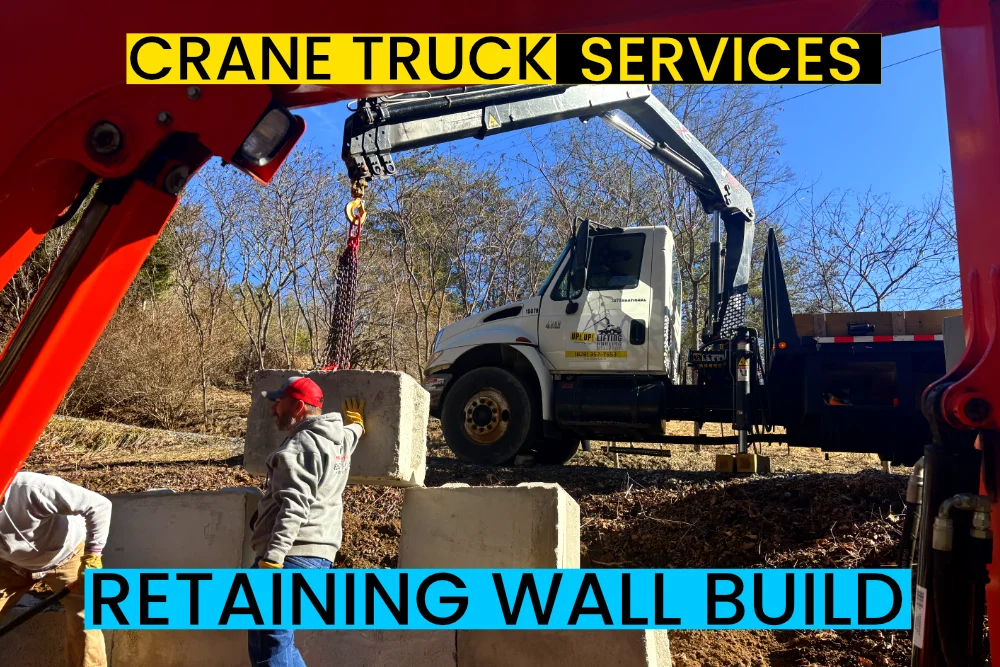
Precast Concrete Block Transport & Placement | Western North Carolina | Up! Up! Lifting When a private landowner in Marshall, NC needed a retaining wall built along their main driveway to combat persistent hillside erosion, they called Up! Up! Lifting. Using our crane truck, we picked up the precast concrete blocks at Carolina Ready Mix & Builders Supply in Swannanoa and Fletcher, transported them to Marshall, and offloaded — placing them precisely during the final build. Our crane truck platform can be a cost-effective solution for transport, loading, and placement, often eliminating the need for additional heavy equipment. The Project: Build Retaining Wall Along a Drive Erosion along the property’s main drive had made a retaining wall a necessity. The solution called for large precast concrete blocks — each measuring 2x2x3 feet and weighing 1,800 pounds — arranged in a stepped, two-row configuration against a terraced hillside. We loaded the precast blocks at Carolina Ready Mix & Builders Supply, at both they’re Swannanoa and Fletcher plants, and transported them directly to the job site in Marshall, Madison County. This is one of the core advantages of Up! Up! Lifting’s crane truck service: we can pick up heavy precast concrete cargo at the source and deliver it without requiring a separate piece of unloading equipment at the destination. Our truck-mounted crane can lift up to 5,500 lbs next to the truck and up to 1,800 lbs at full crane extension — so the same truck that hauls the load can also place the cargo within reach of the truck. Collaboration with Mountain Views Grading & Excavating LLC This project was a great example of two specialized crews working together efficiently. Mountain Views Grading & Excavating prepared the site using an excavator, cutting a back terrace into the hillside in a precise stepped layout — exactly the right foundation for a two-row block wall. Their site prep set us up for clean, accurate block placement from the start. Our articulated knuckleboom crane has a 31-foot reach with a capacity of 1,800 lbs at full extension. For the majority of the wall, we placed each block carefully and quickly with our crane. For sections that fell beyond the limit of our crane’s reach, we worked with the Mountain Views’ excavator operator — positioning blocks within their range so they could attach a chain and complete the final placement. This kind of real-time coordination keeps a job moving safely and on schedule. Crane Truck Requirements for Retaining Wall Projects A crane truck is a highly efficient option for retaining wall block placement — but the right site conditions are essential. To operate safely, our truck requires a level surface within a 5-degree positive or negative grade, and a 12-foot-wide area to deploy the outrigger stabilizers. The job site needs to be clear of overhead obstacles, such as power lines, tree branches, and structures. The project location also needs to be within 31 feet of where the truck can be staged. In the mountain terrain of Western North Carolina, those conditions aren’t always available. When they are, the advantages are substantial — faster placement, greater precision, and fewer pieces of heavy equipment on site. When they aren’t, we still offer real value: even if our crane can’t reach every placement zone, Up! Up! Lifting remains an excellent choice for customers who need heavy precast blocks picked up from a concrete plant or landscaping supplier and delivered on site. We can transport and offload heavy loads without requiring a forklift, excavator or additional crane at the destination, saving time and cost. Lifting Capacity at a Glance Up! Up! Lifting’s truck-mounted crane offers the following lifting capacity: For more information on our precast concrete delivery and crane truck services, visit: https://upuplifting.com/crane-truck-services/precast-concrete-delivery/ Serving Western North Carolina and the Surrounding Region Up! Up! Lifting offers crane truck lift and transport services throughout Western North Carolina, as well as neighboring communities in South Carolina, Georgia, and Tennessee. We are USDOT & MC licensed for interstate transport. Some WNC communities that we regularly serve include Asheville, Black Mountain, Swannanoa, Fairview, Arden, Fletcher, Hendersonville, Weaverville, Marshall, Candler, Old Fort, Marion, Bat Cave, Lake Lure, and the surrounding mountain communities. Whether you’re a homeowner dealing with a sloped or eroding property, a landscaper needing heavy blocks delivered and placed, or a contractor looking for a reliable crane truck partner, we have the equipment and experience to help. Schedule Your Retaining Wall Project with Up! Up! Lifting Ready to get started on your retaining wall, block placement, or heavy material delivery project? Contact Up! Up! Lifting to discuss your needs and check availability for your residential or commercial project.