
Crane Truck Lifting Race Car At Nürburgring

Here’s a crane truck lift that I haven’t done yet – loading a car. This one comes from a recent video published by Misha Charoudin on his YouTube channel. See the lift at timestamp 6:13, https://youtu.be/X6X5qJ3INVQ?si=zW-j6SxpsDl9FMEP&t=373 This video caught my eye since I’ve been interested this application for my crane truck. While my HIAB knuckle boom crane has the lifting capacity and my 16 ft flatbed could hold a car, I’m not currently certified with DOT to carry motor vehicles, nor am I insured for them at the moment. One key to this lift, with lifting capacity and all things being equal, is the spreader bar they’re using. It allows the rigging straps to fully clear the fenders. And the ability for the spreader to adjust to both wheelbase and width, allows the load to sit just right. I’ve seen some pricing on these spreaders, and they aren’t cheep. Without a more consistent revenue stream to justify a purchase this size, I’ll continue on with the non-adjustable version that I’ve fashioned in-house for much lighter lifts. Also interesting is the attachment point on the wheels. I’ve seen it done different ways, but in this case, the webbed straps loop through the spokes on the wheels and around the center hub. Like the truck pictured here, a low tilt deck would be preferred for car transport. It would keep the center of gravity much lower then my bed and allow easier access to the vehicle while loaded. I can see the value of loading with a crane in this scenario, rather than using the roll off tilt bed. Since they’re servicing a race track, I’d imagine that many wrecks and breakdowns result in damaged wheels and drive lines. Being able to simply pluck the car from the ground and not having to roll it on would eliminate all variables of a non rolling car. Not to mention the additional damage that comes with forcibly winching a car onto a tilt bed. These race cars are not headed to the junk yard, so limiting additional damage in transport is imperative. Looking ahead for Up! Up! Lifting, I don’t anticipate getting into vehicle transport. There are plenty of specialized towing and transport businesses out there already. Adding the required DOT certification along the needed insurance would be a burden on the business if I’m not dedicating time and resources to capture that work. It’s still interesting though. For the time being, please contact us for crane services and heavy lifting in the Asheville area of Western North Carolina.
The Week the Dumpster Bags Finally Clicked

A 5-bag pickup day finally proved out our dumpster bag service. Real numbers on pricing, packaging costs, and the flatbed bottleneck we haven’t solved yet.
What Is a Loader Crane? Knuckle Boom, Crane Truck & Loader Crane Explained

If you’ve spent any time researching crane equipment — reading a manufacturer’s spec sheet, browsing a used-equipment marketplace, or talking to an out-of-area contractor — you’ve probably run into the term loader crane. If you’ve only ever heard it called a knuckle boom crane or a crane truck, you might wonder if it’s something different. It isn’t. It’s the same equipment. Here’s the short version, and then the full explanation. The Short Answer A loader crane is a hydraulic, articulated crane mounted on a truck — built with jointed “knuckles” in the boom that fold and unfold like a finger, rather than a single straight boom that telescopes in and out. In the US, this same piece of equipment is most commonly called a knuckle boom crane, and when it’s mounted on a flatbed for delivery work, the whole vehicle is often called a crane truck. Loader crane, knuckle boom crane, articulating crane, and picker crane all describe the same category of equipment. The differences are regional and contextual, not mechanical. Where the Term “Loader Crane” Comes From The name describes exactly what the crane was originally built to do: load and unload cargo onto and off of the truck it’s mounted on. Unlike a standalone mobile crane that’s brought to a site purely to lift, a loader crane is part of the delivery vehicle itself — it loads the truck at the pickup point and unloads (and places) the cargo at the destination. The design originated in Scandinavia in the mid-20th century — HIAB, one of the best-known manufacturers in the category, was founded in Sweden in the 1940s and helped pioneer the hydraulic loader crane in the 1960s and ’70s. That European origin is a big part of why “loader crane” remains the standard term internationally, while North America developed its own parallel vocabulary. Why the US Uses Different Terms Than Other Countries Knuckle boom loader cranes became standard equipment across Europe decades before they gained real traction in North America, where straight (telescopic) boom trucks dominated for longer. By the time articulated cranes built a strong distribution and service network in the US, the industry here had already settled on its own naming conventions — “knuckle boom crane” for the equipment, “crane truck” for the delivery vehicle it’s mounted on. So in the US: Neither term is wrong. They’re just used by different audiences in different contexts. Even the Manufacturers Call It a Loader Crane This is the part that surprises people: the equipment manufacturers themselves — including the one whose crane we run — use “loader crane” as the primary, global product category name. Up! Up! Lifting’s truck is built around a HIAB XS 099 B3 CLX, and HIAB’s own catalog files this exact product line under “loader cranes” worldwide. “Knuckle boom crane” is HIAB’s US-facing label for the same product category. Other major manufacturers in the space — Palfinger, Hyva, Effer, and Fassi — all use “loader crane” as their standard category name as well. In other words: whether you call it a loader crane or a knuckle boom crane, you’re describing the exact same family of equipment our truck is built around. All the Names for the Same Equipment If you’ve seen any of these terms, they all point to the same type of crane: Loader Crane vs. Telescopic (Straight Boom) Crane The other major category of truck-mounted crane is the telescopic (straight) boom crane, which extends and retracts in a straight line using a winch and wire rope — built for maximum vertical reach and suspended loads. A loader crane uses articulated, hydraulic-cylinder joints instead, trading some vertical reach for tight-space maneuverability, faster setup, and precision horizontal placement. For the full comparison — lifting capacities, ideal use cases, and when each type makes sense — see our Crane Truck Benefits Guide: Knuckle Boom vs. Telescopic Cranes. What This Means If You’re Looking for Crane Services in Asheville Whatever term brought you here — loader crane, knuckle boom crane, articulating crane, or crane truck — Up! Up! Lifting operates exactly this equipment throughout Asheville, Black Mountain, and Western North Carolina. Our HIAB XS 099 B3 CLX loader crane is mounted on a 16-foot flatbed (International 4300), with a maximum reach of 31 feet and lifting capacities ranging from 6,305 lbs at close range down to roughly 1,800 lbs at full extension. That combination lets us pick materials up, transport them, and place them precisely — all in one visit, with one vehicle. Looking for loader crane service near Asheville? See our loader crane rental page for Asheville, NC, or explore our full range of crane truck services. Contact Up! Up! Lifting today to discuss your project — no matter what you call the equipment, we know exactly what you need. FAQ Is a loader crane the same as a knuckle boom crane? Yes. “Loader crane” is the international and manufacturer-standard name for the equipment; “knuckle boom crane” is the common US term for the same thing. Both describe an articulated, hydraulic crane with jointed booms that fold like a finger. Is a loader crane the same as a crane truck? Almost — with one small distinction. “Loader crane” refers to the crane itself. “Crane truck” usually refers to the whole vehicle: a flatbed truck with a loader crane mounted on it. Up! Up! Lifting’s vehicle is a crane truck built around a HIAB loader crane. What’s the difference between a loader crane and a regular mobile crane? A loader crane is permanently mounted on a delivery truck and is designed to load/unload that same truck, making it ideal for combined transport-and-lift jobs. A standalone mobile crane is brought to a site solely to lift — it doesn’t carry cargo of its own. Who makes loader cranes? Major manufacturers include HIAB, Palfinger, Hyva, Effer, and Fassi. Up! Up! Lifting operates a HIAB XS 099 B3 CLX. Do you offer loader crane services in Asheville? Yes. Up! Up! Lifting provides operated loader crane (knuckle boom)
There’s No Perfect Crane Truck

There is no perfect crane truck to rule them all. In this installment of the Crane Truck Startup series, I want to share a few things I’ve learned over the past six months since launching my crane truck business, Up! Up! Lifting, in the Asheville, NC area. If you’re considering starting — or have recently started — a crane truck business of your own, I think the information in this series may be genuinely helpful. If you’re already salty, you may simply find my trials, errors, and naive revelations entertaining. Either way, enjoy, and reach out. To those who have been following along on my journey to launch this crane truck company: thank you so much! I’ve been contacted by a number of people — like Michael from Wichita (thanks, Michael!!) and Phillip from New Orleans (where y’at!) — who have shared their plans and offered encouragement. It’s exactly this kind of collaboration and reciprocal support that I created this series for. Let’s keep it going. Six Months In: The High-Level View At a high level, it has taken much longer than expected to find jobs and build a semi-regular revenue base. And yet I’ve been pretty busy, and I’m genuinely pleased with the progress I’ve made. The Main Realization: The Equipment Roller Coaster The biggest thing I want to share in this post is about the equipment — and the process of coming to terms with it. Starting a crane truck business is quite a roller coaster. There’s the excitement of conceiving of your business and launching into a search for your crane truck. Then the realization sets in that you haven’t yet prioritized requirements, specs, and features. You backtrack, form a better idea of the services and markets you’ll serve (another exciting rush), then dive back into the equipment search — only to find that there are very few options to choose from. Fast forward: you’ve found “the one,” commit to buying it, and make the trip to pick it up (because the chance that it’s located anywhere near your town is almost zero). Now the real anxiety hits you like a ton of bricks. It’s that same feeling of buying a car out of town and driving it home — only compounded by the fact that you’re now in a rig, and towing expenses will be on an exponential curve. Aside from the fear of it breaking down — wait, what is that sound?! Has it been doing that, or did it just start? Is that normal?! — you’re also second-guessing your entire business plan. While obsessively monitoring the gauges, you run through every scenario: What if I find work that needs a longer flatbed? What if the crane doesn’t have the reach I need for some jobs? What if a different truck would have been a better fit? Well, after six months of actively working my crane truck business, I can positively affirm those anxieties. Yep — you never could have picked the perfect crane truck. Or at least, there isn’t one out there that can do it all. There will always be jobs that need a different piece of equipment, whether that’s a longer boom, a lighter and more agile platform, more flatbed space or payload, additional features, or something else entirely. The Upside of Frustration On a positive note: the better your marketing is and the more leads you generate, the faster you’ll learn where your crane truck fits in the market. You’ll quickly start to see a pattern in the jobs that are beyond your capabilities. Right now, I turn down about 85% of the inquiries I receive. Yes, it’s very frustrating. And regardless of how clearly you list crane specs in your marketing materials, it makes sense that a customer is simply trying to solve their problem — lift beams, place trusses, load a boulder, move a platform. Their sense of weight, distance, and size is often left for you to evaluate against your actual capabilities. Here’s the flip side of that frustration though: I know what jobs I’m already effectively marketing for, and I know what specs my next piece of equipment needs to have. Or perhaps there’s a single rig configuration that could replace my current setup and open up my capabilities to capture a good chunk of that 85% I’m currently turning away. What Would the Next Rig Look Like? This is where your unique market — and the results of your actual marketing efforts — will paint a different picture for each of you. Here’s what I’m seeing in mine. I’m located in the mountains of North Carolina, so terrain is a major factor. What I keep running into is the need to access challenging job sites where steep roads and tight switchbacks are the reality. I currently have an International 4300, rear-wheel drive — a sub-CDL, single rear axle truck with a 16-foot flatbed. It’s actually ideal for navigating tight switchbacks, and I’ve been able to reach sites that larger crane trucks simply can’t get to. However, it still weighs in at 16,000 lbs, and a four-wheel-drive truck at a similar length would let me reach more locations in more varied conditions. If it’s raining or muddy, I can do very little off-road. Ground protection mats have helped — but only slightly. In my research, I’ve found a handful of trucks, like the Freightliner M2, which has a 4WD version commonly used for forestry or pole work, that would be ideal. The other key spec: a crane reach of around 50 to 60 feet. I’ve probably missed more work due to insufficient reach than any other single specification. This may be a uniquely high need in my specific market, which has a lot of new home construction. I’ve successfully taken on a couple of truss and beam placement jobs on single-level builds where I could get positioned directly beside the structure — but I’ve turned down many more jobs that a 50–60′ reach would have won.
Crane Truck Marketing Strategy: How to Educate Customers and Find Multiple Revenue Streams
The Market Education Challenge When I launched my crane truck business in Western North Carolina, I quickly discovered a fundamental marketing problem: most potential customers don’t know what a crane truck is, let alone when they might need one. Unlike established services like dumpster rentals or excavator work, crane trucks occupy an educational gap in our regional market. This creates both a challenge and an opportunity for a startup crane truck operator. In my previous article about equipment selection, I covered why I chose this particular setup. Now I want to share the marketing realities of introducing an unfamiliar service to a new market. Follow along with this Crane Truck Startup series for a play-by-play on building the business, and learn from my trials, successes, and failures. Get a behind-the-scenes look at launching a crane truck company and learn along with me. Understanding the Crane Truck Awareness Gap Why Crane Trucks Are Unknown in Rural Markets In dense urban areas—think New York, Chicago, or San Francisco—crane trucks are commonplace. Limited workspace and tight access requirements make the all-in-one lifting and transporting capability essential. Contractors in these markets immediately understand the value proposition. But in Western North Carolina’s more rural setting, the market dynamics are completely different: The Articulation Problem The hardest part of marketing my crane truck business has been clearly communicating specific use cases. When someone asks “What do you do?”, answering “I operate a crane truck” typically generates blank stares rather than business inquiries. This is fundamentally different from saying “I rent roll-off dumpsters” or “I provide excavation services”—services where the customer immediately understands the application. It’s worth pausing to point out the irony here. It’s hard to articulate the value of an articulated crane. My Marketing Strategy: Cast Wide, Then Focus Faced with this awareness gap, I made a deliberate strategic choice that goes against conventional marketing wisdom: I decided to market broadly across multiple use cases rather than niche down immediately. The Multi-Service Approach I developed marketing materials showcasing crane truck applications across diverse industries: The Trade-Off: Authority vs. Opportunity I’m aware this broad messaging likely dilutes my website’s topical authority in any single niche. From an SEO perspective, being “the crane truck guy for precast concrete” would probably rank better than being “the crane truck guy for everything.” However, this wide-net approach has proven valuable in the startup phase: Building Long-Term Marketing Assets While I’m casting a wide net for immediate customers, I’m simultaneously building assets for future focused marketing. Content Capture Strategy For every job, regardless of type, I prioritize documenting: This library of real-world applications serves multiple purposes: Multi-Channel Distribution I’m deploying this content across multiple platforms: Each channel serves a different purpose in the customer journey, from initial awareness to final booking decision. The Path Forward: Data-Driven Focusing This broad approach is intentionally temporary. As I accumulate more jobs and data, I’m tracking: Over the next 6-12 months, I expect to identify 2-3 core service offerings that represent the best combination of demand, profitability, and competitive advantage. At that point, I’ll refocus my marketing to establish deeper authority in those specific niches. The Learning Timeline Key Takeaways for Other Crane Truck Startups If you’re starting a crane truck business in a market where the service is unfamiliar: What’s Next in This Series In upcoming installments, I’ll cover: Stay Connected Subscribe to the Up & Up Lifting newsletter for new articles as they publish, or follow along on Facebook, Instagram, and YouTube to see the actual jobs and applications as they happen. FAQ
Learning the Hard Way: Asheville Crane Truck Startup Experiences

When I launched Up! Up! Lifting three months ago, I had big hopes and realistic expectations—or so I thought. My plan seemed solid: start a local crane truck company serving Asheville and Western North Carolina, find clients who needed heavy lifting and hauling, and grow steadily from there. But reality hasn’t followed my timeline. Growth has been slower than expected, and I’ve learned that launching a service business—especially one involving specialized equipment—comes with more complexity than most startup guides ever mention. Check out other articles in this “Crane Truck Startup” series, chronicling my efforts to get an Asheville crane truck business off the ground. Starting a Crane Truck Business in Asheville: What I Learned Fast Before purchasing my crane truck, I spent weeks researching the market and speaking with local businesses that could benefit from crane delivery. The feedback was overwhelmingly positive. Most said they’d gladly hire a local crane truck to move, lift, or place their materials. That confidence carried me forward. But once I was ready for work, only a couple of those same companies followed through. The rest didn’t call—at least not yet. Why Local Interest Doesn’t Always Mean Immediate Business Looking back, I realize I validated interest, not buying behavior. I asked if they needed heavy things lifted—but not how often, under what conditions, or what challenges I might encounter onsite. Crane work is full of variables. Early on, I didn’t fully understand how terrain, ground firmness, slope, weight, and reach distance could make or break a job. My crane truck, with a 16‑foot flatbed and knuckle boom crane, weighs about 13,000 pounds. Even a soft lawn or gentle slope can turn a simple lift into an impossible or unsafe one. Crane Truck Job Challenges: Terrain, Weight, and Safety Considerations I learned the hard way that not every “yes” should be accepted sight unseen. On one job, I was hired to move a large tree root ball said to be “right by the side of the road.” It turned out to be over thirty feet away. In trying to make it work, I pushed the truck beyond its limits and ended up damaging the crane—three weeks in the shop and several thousand dollars in repairs. Another time, I backed down a steep driveway to place a boulder in a customer’s yard. The yard was flat, but grass under the tires left me spinning, unable to climb back out. A fellow contractor towed me to safety. That job ended fine, but it reinforced that terrain and access matter as much as payload weight. Essential Questions to Ask Before Accepting a Crane Truck Job Now, I qualify every lead differently. For each new job, I think about: Asking these questions up front minimizes surprises and protects equipment, property, and schedules. From Early Mistakes to Smarter Lifts: Building Experience in WNC This morning, while finishing this piece, a customer called for a new job. I walked through all the questions above, ran the numbers, and determined it’s a good fit. The project is now booked—and for the first time, I feel genuinely confident about the logistics before I even arrive onsite. Running a crane truck business in Asheville has been humbling, but every challenge has sharpened my judgment and shown me how to better serve customers. Safer, Smarter Crane Truck Services for Asheville and Western NC At Up! Up! Lifting, every job now starts with clear communication, safety checks, and realistic planning. Whether lifting materials for a construction site or delivering landscaping boulders, my goal is to ensure every lift is a success. If you’re planning a lift or heavy delivery in Asheville or anywhere around Western North Carolina, contact Up! Up! Lifting for an honest, experience‑based assessment before scheduling your crane job.
Crane Truck Benefits Guide: Knuckle Boom vs Telescopic Cranes
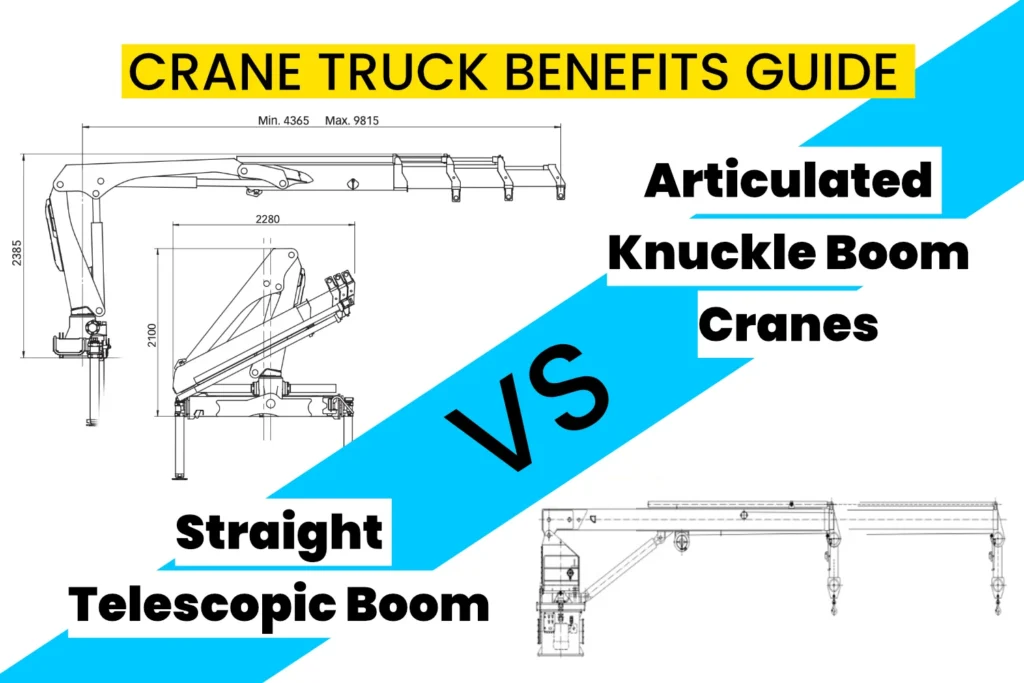
When it comes to moving heavy materials efficiently and safely, crane trucks provide an all-in-one solution that combines transport and lifting capability in a single vehicle. But not all crane trucks are created equal. Understanding the differences between truck-mounted crane types—particularly the advantages of articulated knuckle boom cranes—can help you choose the right equipment partner for your project needs. At Up! Up! Lifting, our International 4300 flatbed features a truck-mounted HIAB articulated knuckle boom crane that delivers exceptional versatility for the diverse material handling challenges we encounter throughout Asheville and Western North Carolina. Understanding Truck-Mounted Crane Types Truck-mounted cranes fall into two primary categories, each with distinct characteristics that make them suited for different applications: Telescopic Boom Cranes (Straight Boom) Telescopic boom cranes feature a straight boom that extends and retracts telescopically, similar to a telescope or radio antenna. The lifting mechanism relies primarily on a winch with wire rope to raise and lower loads. These cranes excel at: Best applications: Utility work, telecommunications infrastructure, high-rise construction, oil and gas operations, and any application requiring maximum vertical reach or extended load suspension. Articulated Knuckle Boom Cranes Knuckle boom cranes feature multiple articulated joints (or “knuckles”) that allow the boom to fold and bend like a human finger or robotic arm. Also known as picker cranes, loader cranes, or articulating cranes, these cranes use hydraulic cylinders rather than wire rope for most lifting operations. Their advantages include: Best applications: Construction material delivery, landscaping, manufacturing, warehousing, marine operations, forestry, and any situation requiring frequent loading/unloading in variable or restricted environments. The Knuckle Boom Advantage: Why Articulated Cranes Excel While telescopic boom cranes dominate certain specialized applications, knuckle boom cranes offer significant advantages for the material handling, delivery, and placement operations that most contractors, builders, and businesses require. 1. Exceptional Maneuverability in Tight Spaces The articulated design of knuckle boom cranes provides unmatched flexibility in confined working environments. The “knuckles” allow for articulation, a bendable action much like the way knuckles move on human fingers, enabling the crane to reach around obstacles, work close to buildings, and operate in spaces where telescopic cranes simply cannot function. This makes knuckle boom cranes ideal for: 2. Compact Design Maximizes Payload Capacity Lighter than conventional boom cranes, the articulated boom is mounted on a truck, which takes up minimal space. This leaves room to carry additional payload on the truck bed as well. When the crane folds compactly behind the cab during transport, more space remains available for cargo. Our 16-foot flatbed can carry up to 12,000 lbs of materials while still providing full crane capability—an efficiency that telescopic boom trucks cannot match since their boom structure typically stows over the cargo bed. 3. Versatile Attachment Capabilities Much like a robotic arm, the knuckle boom can be fitted with various “hands” at its end, such as aerial work baskets, grabs, clamps, pallet forks, breakers, and augers, dramatically expanding the range of tasks a single crane truck can perform. This versatility means one vehicle can: 4. Horizontal Lifting and Low Clearance Operation Unlike telescopic cranes that primarily lift vertically, knuckle boom cranes excel at horizontal lifting and can work effectively in low-clearance situations. The articulating loader crane allows the operator to load or unload the cargo with much less vertical clearance required compared to a straight boom crane. This capability is crucial for: 5. Faster Setup and Operation Unlike traditional cranes, which require assembly and disassembly on site, knuckle boom trucks can be driven directly to the job site and set up quickly and efficiently. The compact footprint means less space is needed to stabilize and operate the crane, reducing setup time and allowing work to begin immediately upon arrival. For contractors and businesses making multiple stops throughout the day, this efficiency translates directly to productivity and cost savings. 6. Superior Operator Safety and Visibility Many knuckle boom cranes offer remote control operation, allowing operators to position themselves for optimal visibility and safety. With traditional cranes, workers must climb up and down the crane to operate it, which can be dangerous and time-consuming. Knuckle boom trucks are operated from the safety of the cab, reducing the risk of accidents and injuries. Up! Up! Lifting’s Knuckle Boom Specifications Our truck-mounted HIAB articulated knuckle boom crane delivers professional-grade lifting capability with the flexibility Western North Carolina projects demand: Maximum Reach: 31 feet with telescoping extension boom Lifting Capacity at Various Distances: Flatbed Capacity: 16-foot bed with 11,000 lbs payload capacity This combination of reach and capacity allows us to handle the vast majority of material handling tasks that contractors, landscapers, building suppliers, and businesses encounter—from placing HVAC units on second-floor installations to delivering palletized materials to tight residential job sites. Important Considerations When Using Crane Trucks While crane trucks offer tremendous advantages, understanding their capabilities and limitations ensures safe, effective operations and realistic project planning. Lifting Capacity Considerations Distance Matters: All cranes lose lifting capacity as reach increases. Our crane lifts over 6,000 lbs close to the truck but reduces to approximately 1,800 lbs at full 31-foot extension. Always plan lifts based on the actual working radius required. Load Weight Accuracy: Knowing the precise weight of materials is essential. Overloading creates safety hazards and can damage equipment. When in doubt, weigh loads before lifting. Dynamic Loading: Swinging or moving loads create additional forces. Factor in a safety margin beyond static weight calculations. Terrain and Space Limitations Stable Ground Required: While our crane can operate on slopes that would challenge larger equipment, a reasonably level and stable surface is essential. Soft ground, excessive slopes, or unstable surfaces may require outrigger pads or alternative positioning. Overhead Clearances: While knuckle booms excel in low-clearance situations, power lines, tree branches, and building overhangs must be evaluated before operations begin. Access Routes: The crane truck must physically reach the work area. Steep mountain driveways, tight turns, narrow gates, and weight-restricted bridges all require assessment during planning. Working Radius: The 31-foot maximum reach defines the furthest distance we can place materials from where the
Defining Crane Truck Services for Your Business

This article is another installment in my “Crane Truck Startup” series, chronicling my efforts to get a crane truck business off the ground. Follow along for a behind the scenes look at building my business and learning crane trucks, heavy lifting, hauling, and everything in between. Picking up from the last article, Early Lessons Starting a Crane Truck Business, I left off at the point of purchasing a vehicle, and how the technical specs of the equipment will dictate the scope of crane services you can offer. This brings us to new ideation phase, researching all the ways your specific crane truck equipment can be used in your unique market and to accomplish the goals of your business. Building on the list that I had initially generated when starting to conceptualize my crane truck business, it’s now time to better define obvious and logical services, while opening up the world of possibilities and uncovering entirely new service options. What Crane Truck Services are Right for Your Business To start, have a completely open and creative mindset for this exercise. You’re trying to uncover any and all possibilities, no mater how crazy or impractical they are. Have fun here. All you’re doing is capturing ideas, you’re not making commitments or mapping the business right now. You’ll find that after writing down a completely outlandish idea, it may spark a tangent thought that leads to a real market need you would have otherwise considered. Capture them all, create a list(s), and start organizing items as you find commonalities. Looking back at my notes from this creative exercise, I initially labeled each bulleted idea as services, and then reorganized them into a hierarchy of revenue streams with services. My thought process here was that a revenue stream represented a higher categorization level, and a service was a distinct sub action or offering. An example here is Junk Removal as a revenue stream category, and Dumpster Bag Service as a distinct service offering. Here’s a fun one… One of the entirely tangent revenue streams that I came up with was mobile sauna rentals. Mobile saunas are a growing category in the U.S. and are not established in the Asheville area. While a sauna business is wildly different than crane truck services, I would have the capability to deliver and place small units with care and precision. I’ve kept this revenue stream in my list as a mid to long-term in initiative, but de-prioritized it do to cost and other factors. By using this categorization approach, I was able to group like services into categories that I ultimately prioritized. I prioritized revenue streams into near, mid, & long-term initiatives that I would pursue. I took into consideration things like: Crane Truck Equipment Requirements & Costs Market Opportunity Economics Brand Fit This brings us to the point of reckoning, the point where you question everything. Is a Crane Truck Service Business the Right Business for You? In future article, I’ll dig into the day-to-day operations of a crane truck service business, the professional skills set, and demands of the job. Up next are some hard lessons learned in my first three months of starting an Asheville-based crane truck business. Depending on where you’re coming from in your career, or perhaps where you hoped you’d go, running a crane truck business will have a different luster for you. For me, I’ve found it exciting, challenging, rewarding, and good fit. I look forward to sharing more next time.
Early Lessons Starting a Crane Truck Business

I’ve learned a tremendous amount in the first three months of starting my crane truck business in the Asheville area of Western North Carolina. Follow along with this Crane Truck Startup series as I share my experiences–the good, the bad, the ups, the downs–while getting my crane truck business off the ground. For those considering starting a crane truck business, I hope you can build on my experiences and avoid some of my failures. I’ll continue to post behind the scenes updates on building my company in this “Crane Truck Startup” series. It’s been three months since starting my crane truck business Up! Up! Lifting. While a lot of time and research led up to buying a truck, the actual purchase really marked the business launch point for me. The vehicle and equipment ultimately define the nature and scope of work that can be performed. More on that in moment. Read more about my crane truck purchase criteria in this earlier article 5 Steps to Start My Trucking Business. So both trucking and heavy lifting are new to me, I have absolutely everything to learn – licensing, regulations, equipment operation & maintenance, pricing, service offerings, and so much more. I would image that most people starting a crane truck business won’t have the same handicaps and the complete lack of knowledge that I have, and would probably bring a background in heavy equipment operation, contracting, hauling…something relevant to this industry. But I hope it’s encouraging to those without relevant equipment and industry experience to know that it is possible. …or at least my terminal optimism at this point is telling that it is! Regardless of whatever background you’re bringing to the table, it will be put to work. If you not a seasoned crane truck operator or driver, you’re probably starting with skills that they don’t have – be it business, marketing, customer service, sales, whatever. Lean into your strengths, while learning this new trade as fast and thorough as you can. Now back to defining the equipment capabilities and service offerings that my crane truck could perform. As soon as I knew the technical specs of the equipment, I went back into the ideation phase, researching the services a crane truck can delivery. I had a great list from my initial research, but now it’s time for blue sky creative exploration again.
Crane Truck 3D Model

Here are two separate crane truck 3D models, using two separate object models – Gaussian splat and photogrammetry. The truck is a 2003 International 4300 with a 16 foot flatbed, and the truck-mounted crane is a HIAB XS 099 B3 CLX. Both 3D models of the crane truck were captured with a DJI Mavic Air 3S drone. Vehicle is used to deliver crane truck services in the Asheville North Carolina area. The first 3D model is a Gaussian splat object model, compiled from aerial video. The second 3D model is a photogrammetry object model, compiled from sequential aerial photographs.